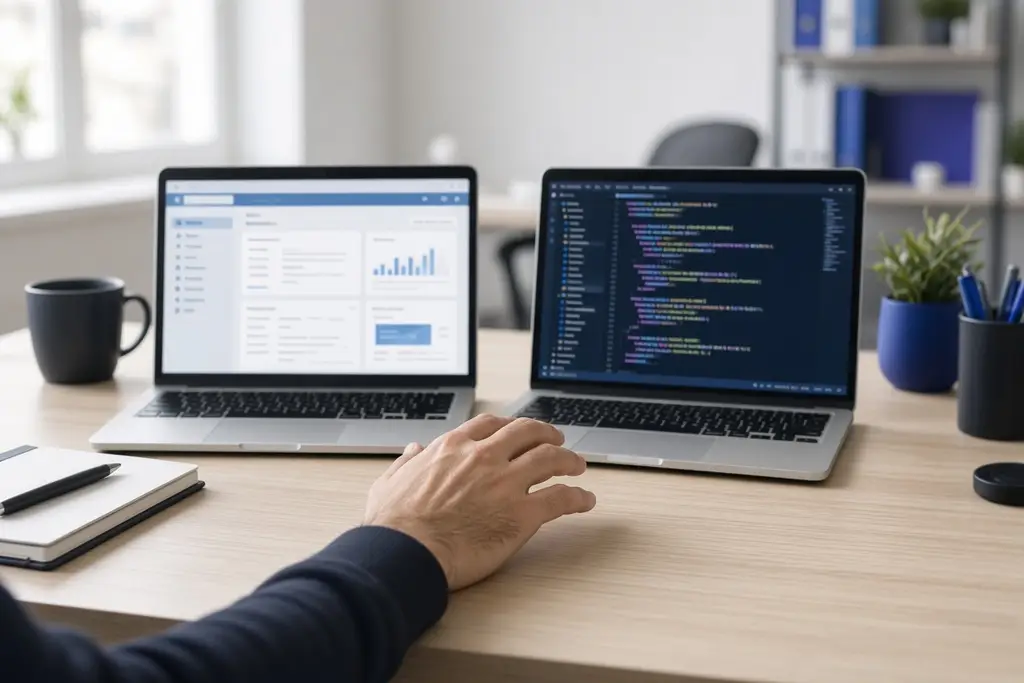
Where does WordPress have the advantage?
For corporate brochure sites, blogs, service pages and projects needing standard content management, WordPress offers a fast and manageable foundation. Its wide theme and plugin ecosystem can reduce development time when chosen carefully.
Its real advantage is that the content team can update pages and posts without technical support. However, too many plugins, a low-quality theme and irregular maintenance can lead to performance and security problems.
- If content will be updated frequently
- If needs are standard corporate features
- If budget and launch time are limited
- If maintenance can be done regularly
When does custom development make sense?
When workflows that standard systems cannot cover, special user roles, heavy data processing or deep integrations with other services are needed, custom development may be the better choice. Because the system is designed around the business model, it carries no unnecessary features.
In return, initial development time and budget are higher. Documentation, testing, security and long-term maintenance require a technical team that can sustain the project. Choosing custom software just to look different creates unnecessary cost for most businesses.
Which questions should drive the decision?
First write down which operations will actually happen on the site. If a ready-made infrastructure securely covers most of those needs, custom development is not a must. If critical functions become fragile with plugins, a custom solution should be evaluated.
In our web design service we evaluate infrastructure not by brand preference but by ease of management, performance and total cost of ownership.
- Who will manage the content?
- How many different integrations are needed?
- How much will traffic and data volume grow?
- What is the maintenance budget over three years?
Is a hybrid approach possible?
In some projects WordPress is used for content management while custom modules are developed separately — combining the two approaches. This model keeps editor convenience while not leaving the unique part of the business dependent on standard plugins.
Before deciding, classifying features as “essential, useful and future” reduces unnecessary development and makes the right infrastructure visible.
The bottom line
Put simply: WordPress gains strength for manageable, standard needs; custom development gains strength for business-model-specific, critical processes.
If you want to apply this to your own business, Explore our web design service or contact our team directly.